
What is time-of-use arbitrage with the EcoFlow STREAM Ultra?
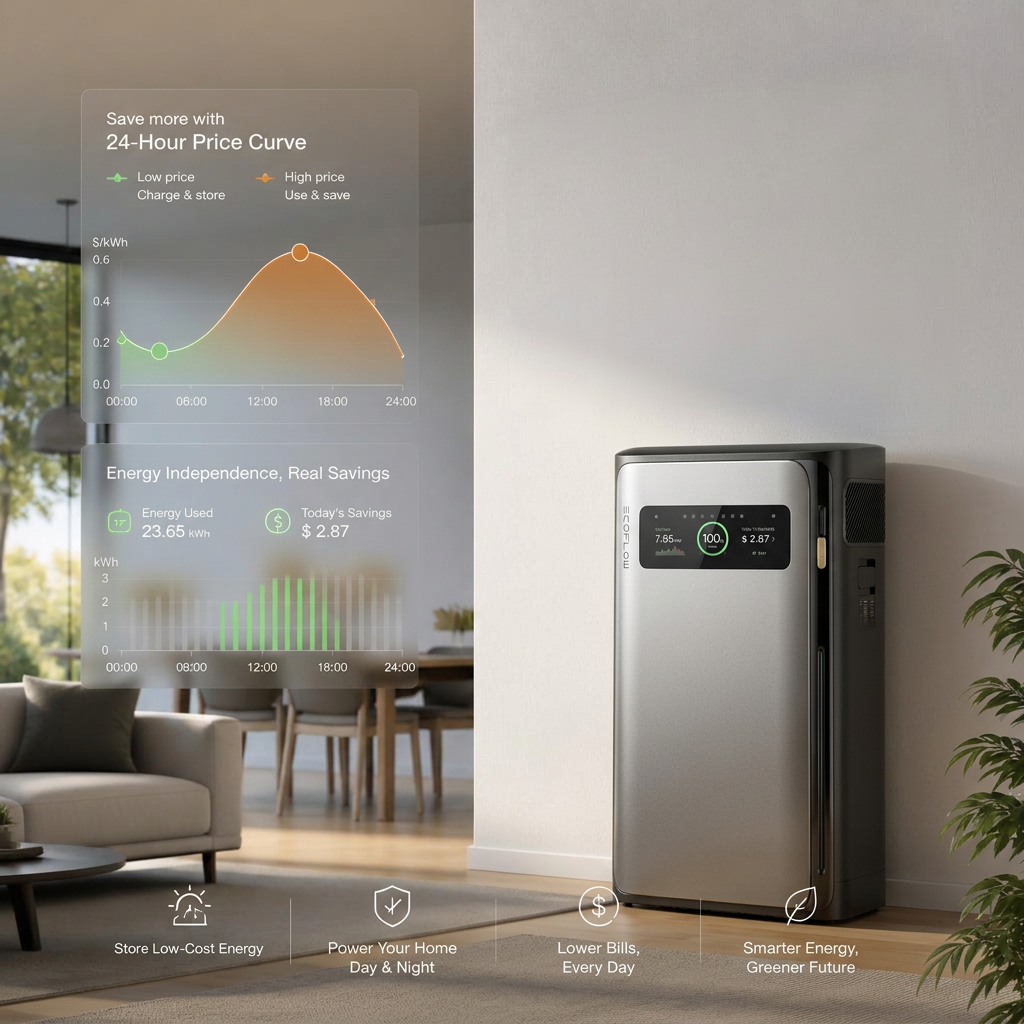
If your utility charges different rates at different times of day, you're on a time-of-use (TOU) plan — and you're probably paying premium prices right when you need power most. Time-of-use arbitrage is a simple idea: buy electricity when it's cheap, store it, and use it when it's expensive. The EcoFlow STREAM Ultra makes this automatic with its built-in LFP battery.
What is time-of-use pricing?
Many utilities now price electricity based on demand throughout the day. Overnight and midday, when demand is low, power is cheap. In the late afternoon and evening — when everyone gets home, runs appliances, and cranks the AC — rates can be two to three times higher. These peak hours are exactly when most households use the most energy.
- Off-peak: lowest rates, usually overnight and midday.
- Mid-peak: moderate rates during shoulder hours.
- On-peak: highest rates, typically late afternoon to evening.
How is arbitrage different from solar self-consumption?
Solar self-consumption is about using the power your panels make instead of pulling from the grid. Time-of-use arbitrage adds a second lever: even when the sun isn't shining, you can charge the battery from the grid at cheap off-peak rates and discharge it during expensive peak hours. Combine the two and your battery is working for you around the clock — soaking up free solar by day and bargain grid power by night, then spending it all when electricity is priciest.
How the STREAM Ultra does it
The EcoFlow STREAM Ultra pairs an LFP battery with a smart microinverter and an app that knows your rate schedule. You tell it your off-peak and on-peak windows, and it handles the rest automatically:
- Charges from your solar panels first whenever the sun is out.
- Tops up from the grid during cheap off-peak hours if needed.
- Holds that stored energy until rates climb.
- Discharges to power your home during expensive on-peak hours, so you buy less high-priced grid power.
Because the LFP battery is rated for thousands of charge cycles, it can do this every single day for years without meaningful wear — which is what makes daily arbitrage practical rather than a novelty.
What does it save?
Your exact savings depend on the size of the gap between your off-peak and on-peak rates — the wider the spread, the more each stored kilowatt-hour is worth. On a typical TOU plan where peak power costs roughly double off-peak, shifting a few kilowatt-hours of evening usage to cheaper stored energy adds up month after month, stacking on top of what you already save from solar.
Is it worth it for me?
Time-of-use arbitrage makes the most sense if your utility has a real price gap between peak and off-peak hours and you use a lot of power in the evening. If you're already on a TOU plan, a STREAM Ultra can quietly trim your bill every day by making sure you're almost never buying electricity at the most expensive moment. Check your utility's rate plan, and if it's time-of-use, the math usually works in your favor.
Share this
Comments
Loading comments…
Leave a comment
Comments are reviewed before they appear.