
Understanding the STREAM Ultra's 4 MPPT Controllers
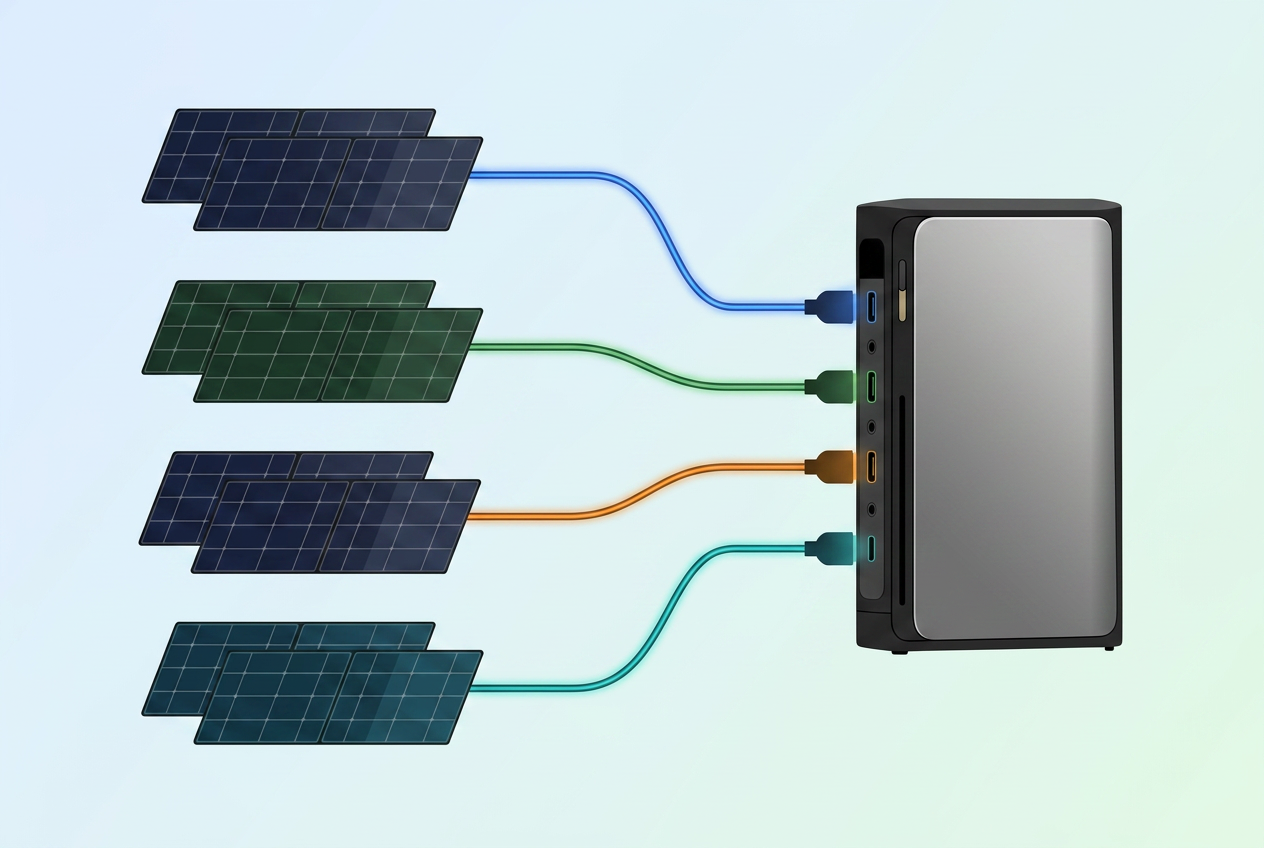
One of the most important — and most misunderstood — specs on the EcoFlow STREAM Ultra is its solar input: “2,000W (4 MPPT).” It tells you two things at once: how much solar power you can connect, and how intelligently that power is managed. Once you understand both halves, it's easy to see why this configuration captures more energy in real-world conditions.
The “2,000W” part: your solar input limit
2,000 watts is the maximum amount of solar power the Ultra can accept from your panels at any moment. With 175W panels, that's roughly 11 panels' worth of capacity before you reach the ceiling. The higher your input, the more energy you capture on bright days and the faster you can refill the battery — so this number sets the upper bound on how much sun your system can turn into usable power.
What is MPPT?
MPPT stands for Maximum Power Point Tracking. A solar panel's ideal operating voltage shifts constantly with sunlight, temperature, and shade — and at any instant there's exactly one “sweet spot” voltage that produces the most power. An MPPT controller is a smart circuit that continuously hunts for that sweet spot and holds the panel there, squeezing out meaningfully more energy than a simpler controller would.
- Tracks the optimal voltage as conditions change throughout the day.
- Recovers energy that a basic (PWM) controller would leave on the table.
- Adapts in real time to clouds, heat, and changing sun angles.
Why 4 MPPT channels matter
Here's the key: the Ultra doesn't have just one MPPT tracker — it has four independent ones. That means you can wire four separate groups of panels, and each group is optimized on its own, completely independent of the others. In the real world, where panels rarely face the same direction or get identical sunlight, that independence is what protects your output.
- Different orientations: panels on an east wall and a south balcony peak at different times of day — each channel optimizes its own group instead of compromising on a single average.
- Partial shading: if a tree or chimney shades one group, only that channel dips. The other three keep producing at full power.
- Staged expansion: add panels in separate spots over time without re-tuning your whole array.
With a single-tracker system, the weakest group tends to drag down the rest — a common frustration known as the “Christmas light” effect, where one underperforming string pulls the whole array down. Four independent MPPTs isolate each group so one shaded or off-angle set of panels can't sabotage the others.
Putting it together
So “2,000W (4 MPPT)” means you can connect 2,000 watts of solar, split across four independently optimized panel groups. This is what makes the Ultra so forgiving of tricky installations: balconies, walls, fences, and yards that face different directions can all contribute at once, each running at its own peak. You get more usable energy from the same panels — especially in the imperfect, partially shaded spots where most plug-in solar actually lives.
If you're planning where to place your panels, don't worry about getting everything perfectly south-facing. Spread them where the sun is, group them by location, and let the four MPPT channels do the optimizing for you.
Share this
Comments
Loading comments…
Leave a comment
Comments are reviewed before they appear.